
Screen Print or In-Mould Label for Haircare Bottles? An A/B Comparison
Screen printing and in-mould labelling are the two routes most haircare teams end up weighing, and they rarely lose to each other on looks. They differ on volume, on tooling, on how the pack behaves in a wet bathroom and on what happens to the bottle at end of life. Choosing between them is a question of run length and of how likely the artwork is to change, not a question of which one is better.
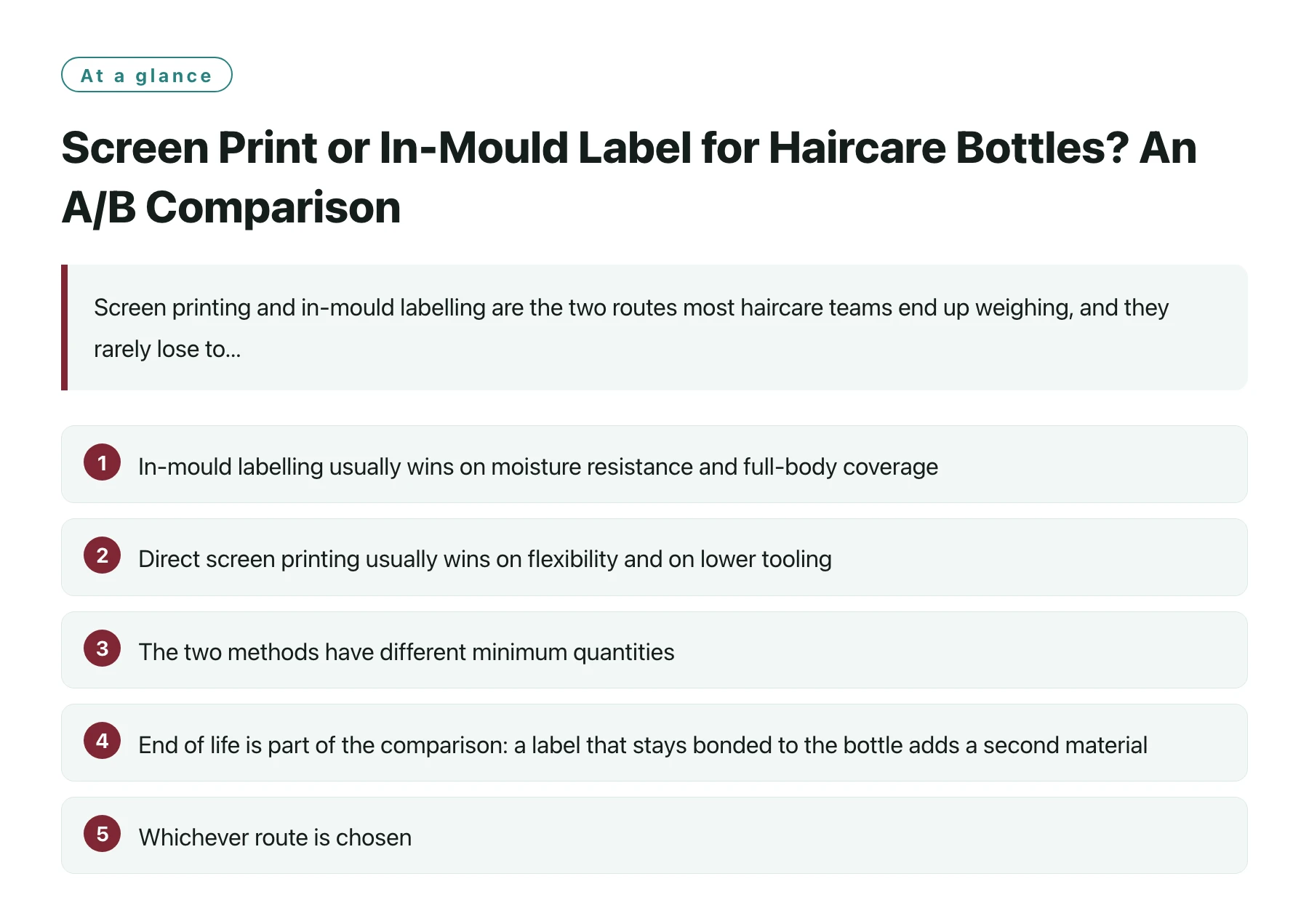
Key takeaways
- In-mould labelling usually wins on moisture resistance and full-body coverage, because the label becomes part of the container wall rather than sitting on it.
- Direct screen printing usually wins on flexibility and on lower tooling, which makes it the practical route for small haircare runs and for ranges likely to be re-skinned.
- The two methods have different minimum quantities, so the decision often flips simply because a first order is smaller than the volume IML needs to be economical.
- End of life is part of the comparison: a label that stays bonded to the bottle adds a second material, while direct print keeps the container closer to a single stream [1].
- Whichever route is chosen, the specification should name the durability tests and the acceptance criteria, because both methods can fail if the substrate, ink or cure conditions are wrong [3].
Haircare bottles live in the least forgiving display environment in beauty. They are opened with wet hands, stored on a wet ledge, squeezed while wet, and often knocked over. Decoration that would be perfectly adequate on a fragrance flacon can fail here in a fortnight.
Screen printing applies ink directly to the container; in-mould labelling places a printed label into the mould so that it fuses into the wall during forming. Both are durable, both can carry multiple colours, and both are used on shampoo and conditioner bottles at scale. The differences are in the economics and in the failure modes.
This comparison scores them across the dimensions that decide real projects: tooling, minimum quantity, durability, design flexibility, lead time and end of life.
Side-by-side on the dimensions that decide projects
| Dimension | Direct screen printing | In-mould labelling |
|---|---|---|
| Tooling | A screen per colour per design; moderate and quick to produce | A label die and, where the container is custom, mould preparation for label placement |
| Minimum quantity | Lower; viable for a first haircare run | Higher; the economics depend on sustained volume |
| Moisture resistance | Good on a compatible substrate with the right ink and cure | Very good, because the label is embedded in the wall |
| Coverage | Usually printed areas rather than a full wrap | Full-body or large-area coverage is straightforward |
| Design change | Change the screen and re-run; relatively forgiving | Change the label artwork and the plate; less forgiving once moulds exist |
| Surface behaviour | Needs a suitable substrate or a pre-treatment on low-energy materials | Handled during forming, so label and container are compatible by design |
| End of life | Ink on a single material; closer to one stream | Label and container are joined, which may complicate separation depending on materials |
| Best fit | Small to mid volumes, glass or PET packs, ranges that may change | High volumes, HDPE or PP bottles, wet environments, full-body designs |
Read the table as a set of constraints rather than a scorecard. On any given project, one or two rows decide the outcome and the rest are context.
The durability question, in practice
Both methods can pass a wet rub test and still behave differently after six months in a shower. Screen-printed ink sits on the surface, so its performance depends on adhesion to the substrate and on the cure. In-mould labelling fuses into the wall, so the failure mode shifts towards the label material and the edge where it meets the container.
For a haircare line, the two tests that separate them are immersion with product contact and repeated wet handling. Ask both suppliers to describe the test conditions they propose and what result counts as a pass, then compare those answers rather than the claims.
One practical note: opacity matters more than it looks. A dark shampoo in a translucent bottle can make a facing label disappear from the front, which is one reason full-body decoration is popular in this category. If the pack is translucent, test the appearance with the product inside rather than empty.
Where a third route quietly beats both
Pressure-sensitive labelling and shrink sleeves often win on small haircare runs for an unglamorous reason: the setup is lower and the artwork can change without cutting a screen or a mould. They are also the easiest routes to update for a seasonal variant or a market-specific text change.
The trade-off is that a label adds a component and an edge, and the edge is where most failures start in a wet environment. A sleeve covers that edge but introduces its own end-of-life question. Neither is a downgrade; both are simply different positions on the volume and flexibility curve.
For launches where the volume forecast is genuinely unknown, starting on a label and moving to direct print or IML once the range settles is a defensible sequence, provided the container design does not have to change to make the move.
A decision rule that survives scrutiny
Ask three questions in order. First, is the annual volume high enough for IML tooling to be carried? If not, the choice is already made. Second, is the pack used in a wet environment with full-body decoration and frequent handling? If yes, IML has a structural advantage. Third, is the artwork likely to change within the pack's life? If yes, direct print or a label is easier to revise.
If the answers conflict, the tie-breaker is usually the container. A custom mould plus IML commits the project to a design for several years, while direct print leaves more room to re-skin the same bottle. The choice should be recorded with its reasoning, because it will be questioned when the second variant is planned.
How to run a fair A/B trial
- Use the same container and the same artworkOne bottle type, one design, two methods. If the containers differ, you are comparing containers as well as decoration.
- Specify the same durability test for bothImmersion, wet rub, product contact and handling, with the same pass criteria and the same laboratory or in-house protocol.
- Price both at two volumesYour first-order quantity and your realistic annual quantity. The crossover between the methods is the useful number.
- Check appearance with product insideTranslucent and dark products change the perceived decoration. Judge the pack as the customer sees it.
- Ask what a design change costsA new colour, a new panel or a market-specific text. The answer separates a flexible route from a committed one.
- Compare the end-of-life positionAsk what the intended recycling route is for each option and whether the decoration is compatible with it.
Beware the pilot that is decorated by hand or on laboratory equipment. Both screen printing and IML behave differently at line speed, and IML in particular depends on how the label is placed and held in the mould. Insist that the pilot comes from production tooling and production conditions. A pilot produced by hand will settle the design question and leave the process question open, which is the opposite of what the trial is for.
Connecting the choice to the rest of the project
If the haircare line is being made under a private label arrangement rather than as a fully owned brand, the decoration choice is often constrained by the range the manufacturer already runs. Knowing how that arrangement allocates design decisions, described for a private label partner for perfume lines, tells you whether you are choosing the method or inheriting it.
It also helps to compare the decoration comparison with the way quotations are built, because the tooling in a decoration quote behaves exactly like the one-off costs in any manufacturing quote. The reading method set out for comparing fragrance manufacturing quotes applies here without modification, and it is the fastest way to see which of the two routes is genuinely cheaper at your volume.
Finally, think about end of life as a market question rather than an ethical one. Packaging requirements in several markets are moving towards verifiable recyclability and recycled content, which changes the cost of a decoration route that has to be revised later. The design guidance published for recyclability is a reasonable checklist to run alongside the decision [2].
The practical summary is short. Choose by volume first, then by environment, then by how much change you expect. Screen printing and in-mould labelling are both capable methods; they simply commit you to different futures. The information a manufacturer publishes about its own scope, readable at Xuelei official site, is worth reviewing only after those three questions have answers.
Sources
- European Commission: Packaging Waste and the PPWR —— EU rules on packaging and packaging waste, including the Packaging and Packaging Waste Regulation requirements on recyclability and design.
- Sustainable Packaging Coalition —— A membership organisation working on more sustainable packaging design, publishing material and recyclability guidance.
- SGS: Cosmetics, Personal Care & Household Testing —— Testing, inspection and certification services for cosmetics and personal care, including microbiological, stability and safety testing aligned with cosmetics GMP.
Frequently asked questions
Is in-mould labelling more durable than screen printing?
For moisture and handling, IML generally has an advantage because the label is fused into the container wall. On a suitable substrate with a correct ink and cure, screen printing is also durable, so the honest answer depends on the material, the product and the tests you agree.
Which method is cheaper for a small haircare order?
Usually direct screen printing or a label route, because IML tooling and minimum quantities are higher. Price both at your first-order and annual volumes to find where the crossover sits for your project.
Can both methods be used in the same range?
Yes, and many ranges do it: a large pack in IML and a smaller pack in direct print, unified by a shared colour reference and approved physical reference set. The risk is a visible mismatch, which the reference set controls.
Does decoration choice affect recyclability?
It can. Direct print keeps the container closer to a single material stream, while a label or sleeve introduces a second material. Emerging packaging requirements in several markets make the end-of-life route worth deciding alongside the design.
What should be tested before committing to a method?
Immersion, wet rub, product contact and repeated handling, on units produced from production tooling. Add a drop test if the pack will be handled in a shower, and check appearance with the actual product inside.
See who's on your site right now.
Reverse-IP enrichment across 41M companies — typically a 38% lift in demo conversion within 60 days.